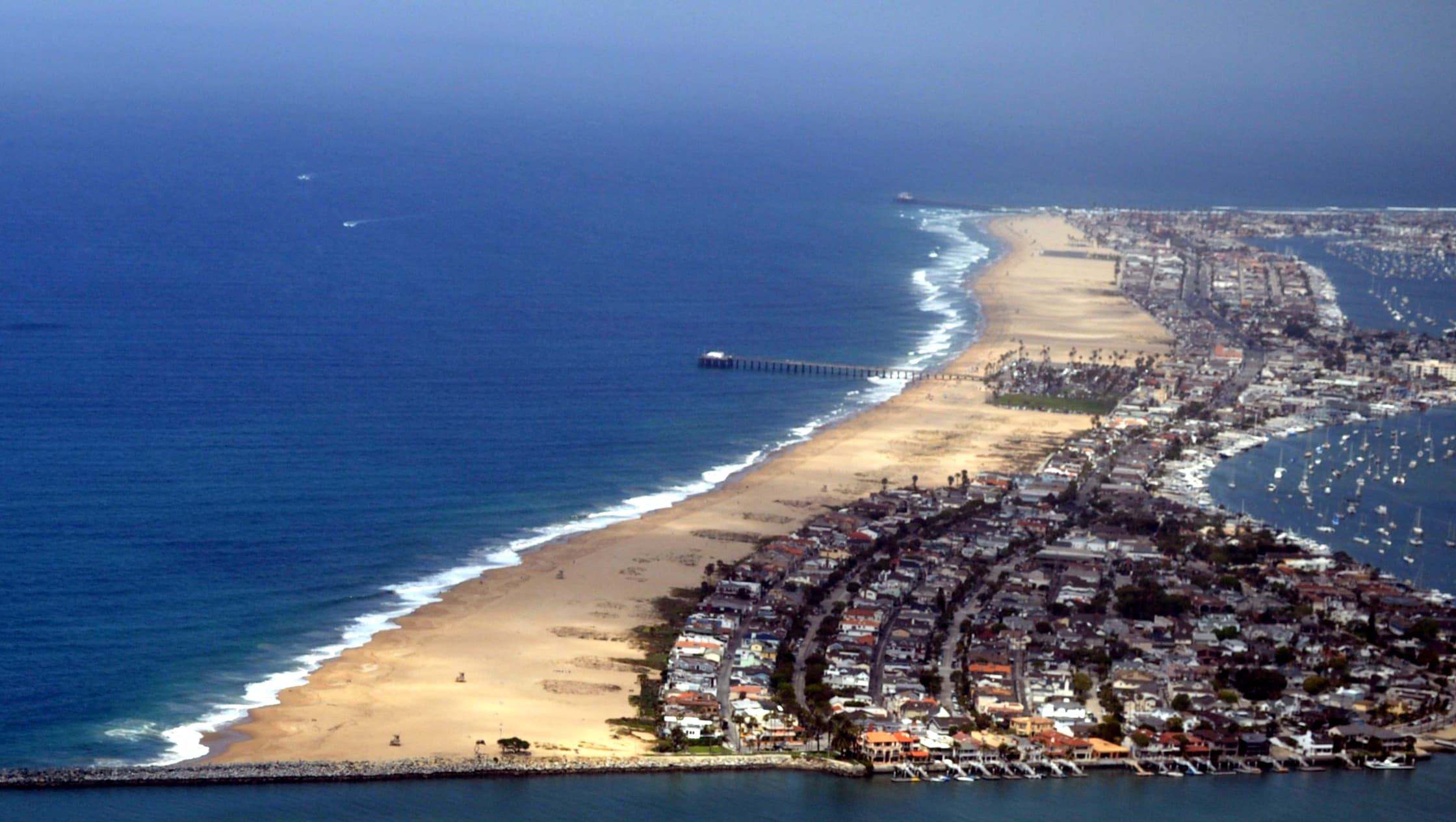
The California Coastal Commission is scheduled Wednesday, Oct. 7, to consider permits for new concrete seawalls at two neighboring bayfront homes on the Balboa Peninsula in Newport Beach, where previous owners built a wood wall across the sandy shoreline without permits in the winter of 2018-2019. Commission staff recommend approval with eight special conditions, including a combined $43,287.82 payment toward public access improvements in Newport Harbor.
The applications, Nos. 5-26-0220 and 5-26-0221, were filed by Atef Rafla and Andy Howard for the adjacent lots at 1805 and 1807 E. Bay Ave., near the eastern tip of the peninsula between J and K streets. The owners would tear out the unpermitted wood wall and build a 30-foot concrete seawall on each lot, 60 feet in all, set on concrete-filled piles with a 3-foot-6-inch stem wall on top, plus new wood steps down to the beach.
The two lots are among the few remaining bay-facing lots on the peninsula without a bulkhead or seawall, according to the Sept. 24 staff report. When the homes were rebuilt in the 1990s and early 2000s, commission staff found the sites safe from erosion and flooding, and no seawall was proposed or approved. The owners' consultants now say boat wakes, tidal currents and strong Santa Ana winds are eroding the shoreline; sand dredged from the dock berths and placed in front of the sites in 2017 was mostly gone by 2018, the report says. Staff concurred that a seawall is needed to protect neighboring homes, the public street and other infrastructure from flooding, citing projections of almost 5 inches of sea level rise by 2030.
The owners first proposed lining up the new walls with the bulkhead-like structures on the neighboring lots. To reduce filling of intertidal habitat, they agreed to pull the walls back 4 feet and tie them to the neighbors with short return walls. Even so, about 686 square feet of wet sand would end up behind the walls, about 472 square feet at 1805 E. Bay Ave. and 214 square feet at 1807. Staff wrote that the alignment still does not qualify as the least environmentally damaging alternative, but that it is the farthest landward the walls can go and remain structurally stable.
Because no program exists in Newport Harbor to restore lost soft-bottom intertidal habitat, the owners would pay an in-lieu fee of $19.37 a square foot, a rate staff based on the current cost of sand for beach replenishment, plus $30,000, or $15,000 each, to resolve the unpermitted wall. The money would go into an interest-bearing account run by the City of Newport Beach, the California Coastal Conservancy or another entity the commission's executive director approves, and must be spent on public access to Newport Harbor within five years.
The report lists the habitat portion as $10,692.24 in several places, but its own formula, 686 square feet at $19.37, works out to $13,287.82, the figure that produces the $43,287.82 total required by the permit's mitigation condition.
Other conditions bar any future seaward expansion of the walls, require the owners to assume the risk of flooding and erosion and to record a deed restriction, and waive rights under Public Resources Code Section 30235 to armor farther out. The stem wall is designed so it can be raised later from 11 feet to 14.4 feet above the NAVD88 datum without moving seaward. Public access to the harbor remains at the J Street street end, about 60 feet west of the sites, and the K Street street end, about 90 feet east. A 2024 city survey found eelgrass meadows in the shallow bay waters just beyond the federal bulkhead line.
Sources & methodology
This report was written from the primary materials below. Links open at the original publisher.
California Coastal Commission staff report W16b & W16c, CDPs 5-26-0220 and 5-26-0221 (Sept. 24, 2026)See something we should correct? Read our corrections policy.