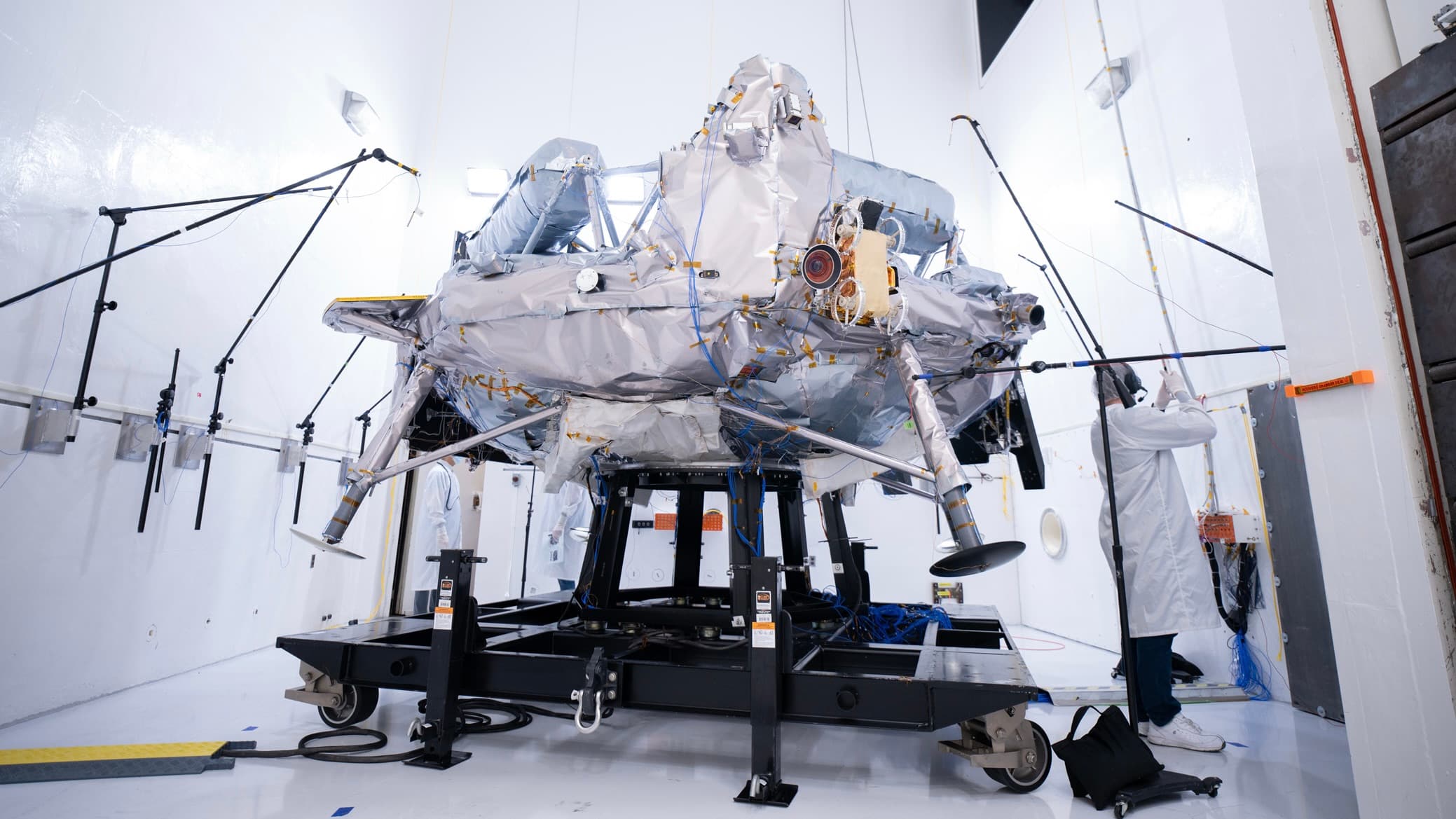
A commercial lunar lander built for NASA’s Moon Base program has passed a series of environmental tests at NASA’s Jet Propulsion Laboratory in Southern California, NASA said Tuesday. The tests simulated the extreme temperatures and vacuum of space and the shaking and roar of launch for Voyager Technologies’ Griffin Mission One, or Griffin-1, which is expected to launch later this year aboard a SpaceX Falcon Heavy rocket.
Testing began in July after the 2,789-pound (1,265-kilogram) spacecraft took a cross-country road trip from Voyager Lunar Systems’ manufacturing facilities in Pittsburgh to JPL in the San Gabriel Mountain foothills. On July 20, engineers spun the lander on a special table in JPL’s Environmental Test Laboratory to measure its mass properties, a test that looks for unexpected wobbles in how the vehicle will move through space.
Griffin-1 also went through electromagnetic interference and compatibility testing in an anechoic chamber whose walls are lined with long foam spikes; vibration testing on a “shaker table” that rattled it in three directions while hundreds of sensors monitored it; and, on Aug. 12, acoustic testing in which giant horns powered by compressed nitrogen gas blasted it with up to 153 decibels inside a sealed chamber.
The campaign culminated in JPL’s 25-Foot Space Simulator, a thermal vacuum chamber listed on the National Register of Historic Places for its role in the Ranger, Surveyor, Mariner and Voyager programs; crews used a crane to position the lander inside on Aug. 31. For about two weeks beneath the chamber’s 85-foot (26-meter) ceiling, Griffin-1 alternately baked at up to 167 degrees Fahrenheit (75 degrees Celsius) and froze at temperatures as low as minus 148 F (minus 100 C).
“NASA JPL’s Environmental Test Laboratory has been putting robotic explorers to the test since the Ranger program gave us NASA’s first up-close views of the Moon’s surface in the mid-1960s. We’re proud to provide our expertise and facilities to support this new phase of commercial lunar exploration,” said Charles Whetsel, manager of the Exploration Systems Development Office at JPL.
Griffin-1 flies under NASA’s Commercial Lunar Payload Services initiative and is to deliver more than 1,100 pounds (455 kilograms) of cargo to Nobile Crater near the lunar South Pole, which makes it an infrastructure-class lander. It will carry 10 science and technology demonstrations from six countries, including Astrolab’s FLIP rover, which NASA calls the largest commercial payload ever delivered to the Moon.
“Seeing the spacecraft complete this demanding environmental testing is a major milestone because it demonstrates that Griffin-1 is ready for the extreme journey ahead: launch, through deep space, to the lunar South Pole,” said John Thornton, executive vice president at Voyager. The lander has returned to Voyager Lunar Systems’ facility for final assembly; launch-readiness operations come next, before it ships to Cape Canaveral.
Sources & methodology
This report was written from the primary materials below. Links open at the original publisher.
NASASee something we should correct? Read our corrections policy.