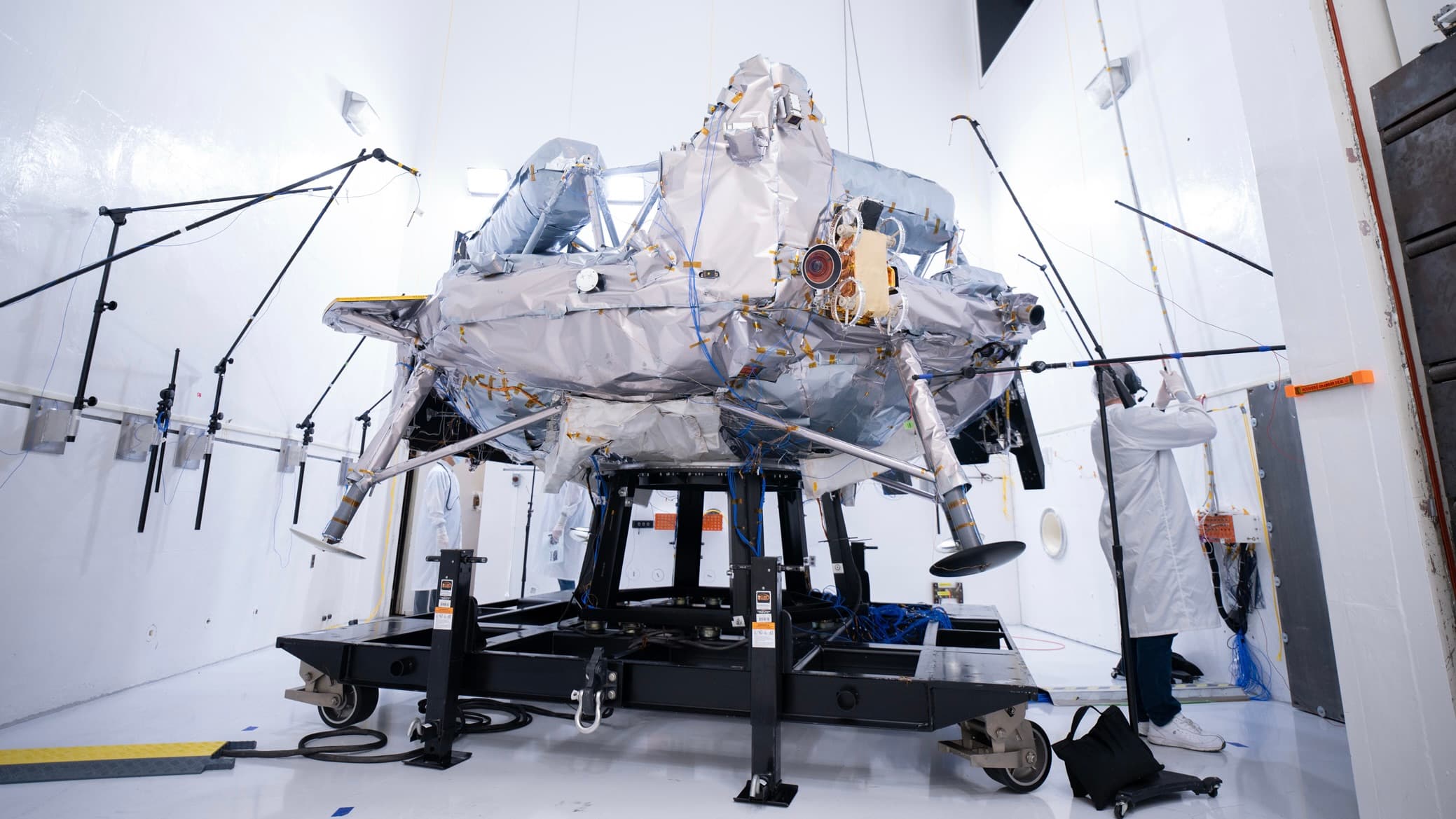
NASA said Saturday that its Jet Propulsion Laboratory in Southern California, a division of Caltech, will manage and build PROMISE, a nuclear-powered rover bound for the Moon’s south pole. The agency shared the news at the MAX POWER aerospace expo at Kennedy Space Center in Florida.
PROMISE, short for Polar Rover for Observation, Mapping, and In-Situ Exploration, is a six-wheeled rover NASA said will characterize the surface and subsurface, assess resource potential and help inform landing-site selection and future infrastructure. The nuclear-powered rover can operate during long lunar nights and inside permanently shadowed regions thought to hold ice, which NASA called crucial to a sustained presence on the Moon.
JPL will assemble the rover from spare flight components and engineering test models built for NASA’s Curiosity and Perseverance Mars rovers, the agency said. Using proven hardware, software and Mars-rover operating approaches is intended to cut cost and shorten integration and testing. NASA said it has assessed the hardware’s compatibility with the lunar environment and determined it can tolerate conditions near the south pole.
The rover will carry a drill to extract regolith from about 3 feet (1 meter) below the surface so scientists can look for ice and other resources, along with spectrometers, temperature and radiation sensors and visible-light cameras. It will also demonstrate NASA’s High Performance Spaceflight Computing system and advanced autonomy sensors and algorithms. NASA is targeting a late 2028 launch and planning an 18-month mission.
NASA awarded Blue Origin a $94 million base contract, with an option worth an additional $140 million based on performance, to deliver PROMISE to the lunar south pole on Blue Origin’s Mark 1 lander. The agency said the award expands a task order issued in May 2026 to deliver two lunar terrain vehicles.
The rover announcement came with a broader set of Moon Base cargo and transportation awards. NASA selected eight companies for CLPS 2, the next phase of Commercial Lunar Payload Services: Blue Origin, Firefly Aerospace, Intuitive Machines, ispace-U.S., Lockheed Martin Space, Northrop Grumman Space Systems, SpaceX and Voyager Technologies. The CLPS 2 framework is a 10-year, multiple-award, indefinite-delivery/indefinite-quantity master contract with a combined maximum value of $10 billion.
NASA also increased the value of the existing CLPS 1 contract from $2.6 billion to $4.2 billion. The original contract remains in place through November 2028, with an additional five-year period to finish awarded deliveries through November 2033.
Separately, NASA awarded six task orders worth about $1.3 billion combined under its Venture-Class Acquisition of Dedicated and Rideshare contract to Arrow Science and Technology, Blue Origin and Impulse Space to integrate and transport Moon Base cargo. Those orders fall under a 10-year contract family with a maximum total value of $5 billion. NASA said some missions will fly on Blue Origin’s New Glenn, Relativity Space’s Terran R and SpaceX’s Falcon 9, with in-space transportation spacecraft from Blue Origin, Firefly Aerospace, Impulse Space and Quantum Space.
NASA also selected SpaceX, under an existing lunar logistics contract, to fly a Cislunar Communications Deployment Demonstration on Starship in 2028 to test communications satellites for future lunar networks.
“We are building the Moon Base mission by mission,” NASA Administrator said.

Federal
Jared Isaacman
Administrator, NASA
Named once in this story.
Portrait: Bill Ingalls / NASA via Wikimedia Commons (public domain)
Sources & methodology
This report was written from the primary materials below. Links open at the original publisher.
NASASee something we should correct? Read our corrections policy.