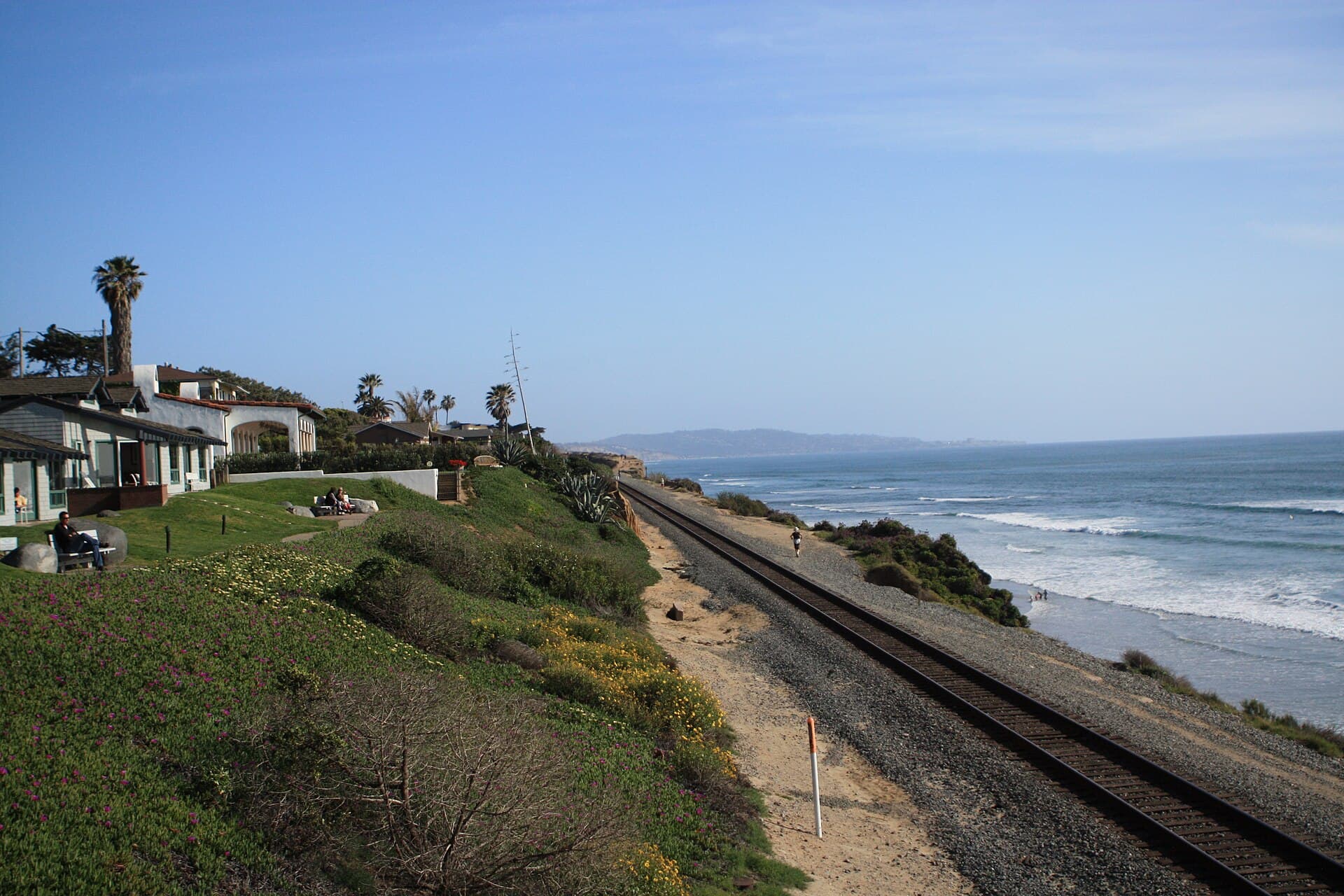
California Coastal Commission staff are recommending that the commission take up an appeal of a Del Mar homeowner's plan to replace a chain-link fence on leased railroad land with a 5-foot-tall glass fence, warning that the city's approval could interfere with a public bluff-top trail the San Diego Association of Governments is required to build. The commission is scheduled to consider the appeal, No. A-6-DMR-26-0018, on Thursday, Oct. 8.
Del Mar's director of planning and community development approved the project at 117 6th Street on June 30, according to a Sept. 24 staff report that lists the applicant as Integrated Professional Services LLC, Michael McMillan. Along with new walls, a stone panel and a glass gate on the residential lot, the approval covers replacing an approximately 3-foot-tall chain-link fence on North County Transit District property west of the house with a 5-foot-tall transparent glass fence and gate. The owner leases that strip from NCTD for landscaping and beautification under an agreement dating to at least June 2023, which was amended in July 2025 to allow a glass fence 5 feet high and 238 feet long, the report says.
Commissioner Ann Notthoff and Vice Chair Caryl Hart filed the appeal. Staff agreed that it raises a substantial issue, finding that the city wrongly treated the railroad as the first public road paralleling the sea. Under the Coastal Act definition, staff wrote, that road is Stratford Court, which puts the site between the first public road and the sea and requires public access findings the city never made.
The larger concern is a trail. In 2022 the commission conditionally concurred with SANDAG's Del Mar Bluffs Stabilization Project 5, which adds bluff stabilization and seawall structures along a 1.6-mile segment of the NCTD right-of-way to keep the railroad running until it can be moved off the bluffs. As mitigation, SANDAG must plan, design and build an enhanced north-south trail east of the tracks between Seagrove Park and 4th Street. Near 117 6th Street, that trail is expected to follow an existing public path in the NCTD right-of-way above the tracks, next to a concrete drainage swale.
Staff wrote that authorizing or maintaining private encroachments along that alignment "would potentially preclude options for the timely completion, maintenance, and adaptive capacity" of the trail, and that the city's decision could set an undesirable precedent for similar encroachments. The report notes that coastal access trails have been present in the area since the rail line first came into use in 1910 and that the city's own land use plan describes the bluff-top paths as used by many people daily.
The report also cites hazards. The nearby bluffs are generally 50 to 70 feet high, have a history of landslides and retreat an average of 0.4 to 0.6 feet a year, pressures staff expect sea level rise to worsen. Staff said the fence could compromise drainage and stabilization options for protecting the railroad and make it harder to site and maintain the trail safely.
The commission will not take testimony on the substantial-issue question unless at least three commissioners ask for it. If it finds a substantial issue, the project would get a full de novo hearing at a future meeting, where any member of the public may testify.
Sources & methodology
This report was written from the primary materials below. Links open at the original publisher.
California Coastal Commission staff report Th9a, appeal A-6-DMR-26-0018 (Sept. 24, 2026)See something we should correct? Read our corrections policy.