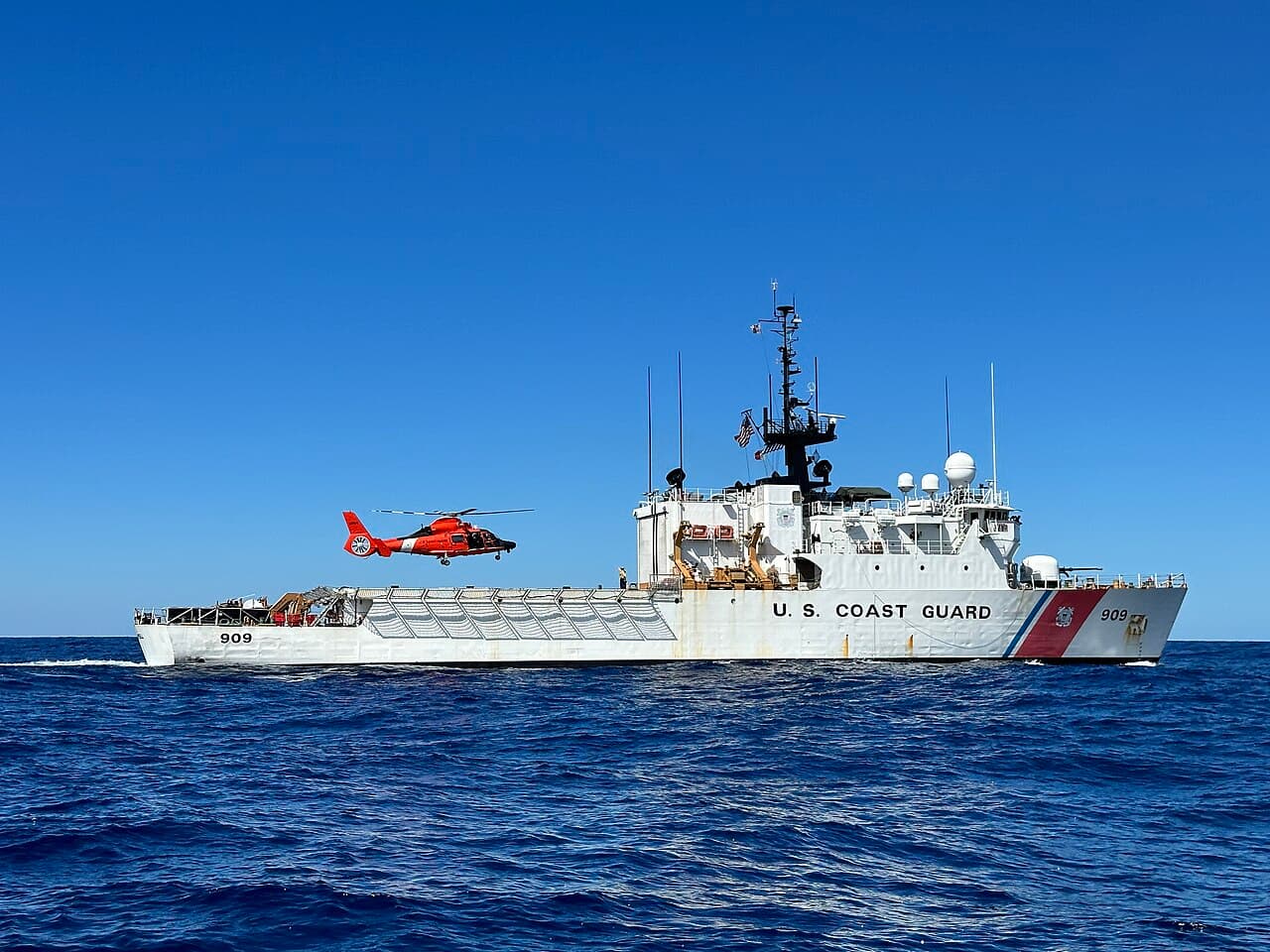
Source claim (NASA, Margo Pierce): On Memorial Day weekend 2024 a five-person fishing team sank about 40 miles off the Mississippi Gulf Coast. One team member activated a personal locator beacon (PLB). A U.S. Coast Guard boat rescued the five after roughly four hours in the water.
Source claim (NASA): The emergency signal was received by the Search and Rescue Satellite-Aided Tracking system, or SARSAT. SARSAT operations in the U.S. began in 1982 and became international in 1985. NASA says the program now involves 62 operational satellites and 45 nations and that more than 63,000 lives have been saved.
Source claim (NASA): PLBs operate on 406 megahertz. A beacon transmits location and, when available, GPS data to orbiting SARSAT satellites. Satellites relay the signal to the nearest ground station. Mission control then alerts rescue coordination centers to dispatch resources. Registered ResQLink PLBs also notify an owner’s emergency contact. NASA notes typical PLB batteries last five to 10 years.
Analysis (The Journal): Satellite-aided beacons provide a reliable alert mechanism where commercial wireless coverage is absent. The Barrett case shows a PLB can convert an otherwise invisible emergency at sea into a directed rescue response.
Inference (The Journal): For people who travel offshore or into remote areas, carrying a registered PLB and maintaining its battery is likely to materially increase the chance of being located quickly. This inference follows from the described signal path and the reported Coast Guard response in the cited incident.
Limitations and unknowns (Source claim and The Journal analysis): NASA reports aggregate outcomes—62 satellites, 63,000+ lives saved—but the agency’s article does not detail how rescues are counted or how responsibility is apportioned among participating nations and agencies. The source also does not provide typical detection latency, time-to-rescue distributions, or failure modes for beacons in adverse conditions.
Practical consequence (The Journal): Boaters and remote travelers should carry, register and periodically replace the battery on a PLB designed for 406 MHz service. The device must be activated to produce a distress alert.
Source quote (from the incident participant, as reported by NASA): “If that will save one life, it’s worth the effort.”
Sources & methodology
This report was written from the primary materials below. Links open at the original publisher.
NASASee something we should correct? Read our corrections policy.